
Any questions ?
Please email questions to shalom@tov/com
Notice: Test mode is enabled. While in test mode no live donations are processed.


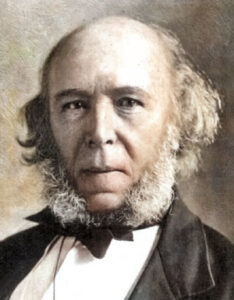 Herbert Spencer (27 April 1820 – 8 December 1903) was an English polymath who developed the idea of Social Functionalism primarily in the context of social theory and biology. Both he and Charles Darwin focused on theories of evolution, Darwin on biology before the advent of genetics, and Spencer, before the advent of Politically Correct dictating what is Socially Correct.
It was Spencer who coined the phrase “Survival of the Fittest” describing human being’s social structures. Darwin picked up on the phrase to describe how life evolves.
Spencer’s version of functionalism can be broken down into a few key components, centered on the idea that societal structures and institutions, as well as organisms, evolve to perform functions that contribute to the survival and stability of the larger system.
1. Organic Analogy: Spencer’s functionalism draws heavily on the organic analogy between society and a living organism. Just as the parts of an organism (such as the heart, lungs, and digestive system) work together to maintain the health and functioning of the whole body, the different parts of society (such as institutions, norms, and values) work together to maintain social stability and order. According to Spencer, each institution or social structure has a role or function that contributes to the overall functioning of society.
2. Evolutionary View of Society: Spencer applied the principles of biological evolution to social development, famously asserting that society, like organisms, evolves over time. His perspective was rooted in the belief that societies progress through stages, from simple to more complex forms. He saw social change as a gradual process where each part of society adapts to meet the needs of the whole, contributing to the continued survival of the social system.
3. Social Evolution: Spencer believed that societies evolve in ways similar to biological organisms, with social structures becoming more specialized as they develop. He emphasized the importance of adaptation: just as organisms adapt to their environments to survive, social institutions evolve to meet the needs of the society, and only the most adaptable systems survive. In this sense, Spencer saw social progress as a product of natural selection within human societies.
4. Minimal Government Intervention: Spencer was a libertarian in his political beliefs and argued that government should play a minimal role in society. He thought that social problems would be best solved by allowing natural social processes to unfold without interference. In this sense, Spencer’s functionalism was linked to his belief in the free market and limited government, as he believed that social and economic systems would naturally adapt and function more efficiently without heavy regulation.
5. Teleology: Spencer’s functionalism can also be considered teleological in nature, meaning that he viewed the development of society and its structures as being directed toward a specific purpose or end—namely, the survival and prosperity of society as a whole. He believed that each part of society had an inherent function that contributed to the greater goal of social cohesion and survival.
Spencer’s functionalism laid the groundwork for later sociological thinkers like Émile Durkheim, who expanded on the idea that social institutions function to maintain social order. However, Spencer’s application of Darwinian principles to social theory has been criticized for promoting a form of social Darwinism, which justified inequality and limited social reforms by arguing that the survival of the fittest applied to human societies.
Herbert Spencer’s functionalism revolves around the idea that societal structures and institutions evolve to perform specific functions, contributing to the survival and stability of society, much like the parts of an organism work together to maintain the health of the body. This evolutionary view of society is coupled with a belief in minimal state intervention, which Spencer thought would allow natural social processes to unfold.