Introduction to Raymond Ibrahim's Work
We live in a Not-So-Brave New World where ideas and truth are routinely suppressed by competing narratives backed by money and power. Voices speaking truth to power are routinely suppressed. Raymond Ibrahim is one such voice whose clear vision of reality does not coincide with certain powerful interests.
He is a prolific author and outspoken advocate for raising awareness about the persecution of Christians, particularly in Muslim-majority countries, and for addressing the historical and ongoing challenges posed by Islamic extremism.
Historian and author Raymond Ibrahim joins The Winston Marshall Show for a powerful, eye-opening conversation on the hidden history of Islam’s conquest of the Christian world—and why so few dare to speak about it today.
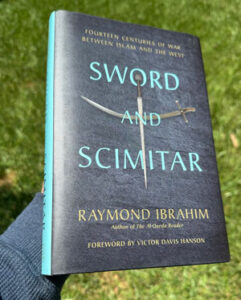
Sword and Scimitar: Fourteen Centuries of War between Islam and the West
Raymond Ibrahim’s Sword and Scimitar: Fourteen Centuries of War between Islam and the West (2018, Da Capo Press) is a historical account that traces the conflicts between Islam and the West from the 7th century to the modern era. The book focuses on eight pivotal battles—Yarmuk (636), Tours (732), Manzikert (1071), the sieges of Constantinople (717–718 and 1453), Vienna (1529 and 1683), and the Crusades in Syria and Spain—to argue that these clashes reflect enduring cultural and religious fault lines. Ibrahim, a Middle East and Islam scholar fluent in Arabic and Greek, relies on primary sources in these languages, as well as Latin and Turkish, to provide detailed narratives of each battle and their broader historical implications. The book frames these conflicts as part of a continuous Islamic jihad against Christendom, beginning with the Prophet Muhammad’s reported demand for the Roman emperor to convert to Islam, and connects historical patterns to contemporary issues, such as the rise of the Islamic State.
Key Themes and Arguments
Ibrahim’s central thesis is that Islamic expansion through jihad has been a consistent driver of conflict with the West, characterized by religious motivations rather than purely political or economic factors. He argues that these wars, often forgotten or minimized in modern historiography, shaped the cultural and political dynamics between Islam and the West. The book emphasizes the brutality of these conflicts, including the treatment of non-combatants and the enslavement of captives, drawing parallels to modern jihadist movements. Ibrahim also challenges what he sees as revisionist narratives that downplay the religious motivations behind Islamic conquests, asserting that jihad was a core tenet of these campaigns.
Scholarly Praise
The book has received praise from scholars for its detailed research and engaging narrative. Victor Davis Hanson, a military historian and Senior Fellow at the Hoover Institution, describes it as “a first-rate military history and a product of solid scholarship and philological research” in the book’s foreword. Thomas Madden, an award-winning historian of the Crusades, calls it “an edgy and eye-opening introduction to a millennium of warfare between the Muslim and Christian worlds before the modern age.” The Midwest Book Review lauds it as “an exceptional work of outstanding scholarship” that reads like a “deftly crafted novel” due to its vivid storytelling. Reviewers on platforms like Amazon commend its reliance on primary sources, with one noting, “Ibrahim’s work, detailed and thorough, is a must-read for anyone who wishes to understand the worldview and practices behind modern Muslim cultures.”
Critiques
Despite its scholarly praise, Sword and Scimitar faces indirect critique for its interpretive framework and selective focus. John Esposito is prominent scholar of Islam at Georgetown University. He has not directly reviewed the book, but his broader work emphasizes the diversity of Islamic thought and cautions against reducing Islam to a monolithic, violent ideology, as Sword and Scimitar does.
Esposito’s scholarship, such as in The Future of Islam, critiques narratives that overemphasize jihad as the defining feature of Islam, suggesting that Ibrahim’s focus on violent conflicts risks oversimplifying a complex religion with varied historical and cultural expressions.
Carole Hillenbrand, a noted historian of Islamic history at the University of Edinburgh, similarly has not written a direct critique of Sword and Scimitar. However, her work generally, and particularly The Crusades: Islamic Perspectives, emphasizes the need for balanced historical accounts that consider Muslim perspectives and the broader socio-political contexts of conflicts.
Other critiques, such as those on Reddit’s r/AskHistorians, express concern about the book’s thesis appearing “extreme” and potentially biased due to Ibrahim’s background as a critic of Islam. Critics note that while the battle accounts are historically sound, the overarching narrative may overemphasize Islam’s role as a ceaseless aggressor, potentially aligning with Samuel Huntington’s controversial “Clash of Civilizations” framework, though Ibrahim does not cite Huntington directly.
The New York Journal of Books review acknowledges the book’s informative nature but suggests it may discomfort readers with its stark portrayal of jihad, particularly in its depiction of violence against non-Muslims.
Strengths and Weaknesses
The book’s strengths lie in its meticulous use of primary sources, which provide vivid, firsthand accounts of historical events, and its accessibility to a general audience. Ibrahim’s fluency in Arabic and Greek allows him to present underutilized perspectives, particularly from Muslim chroniclers, adding depth to the historical record. The narrative style is engaging, blending detailed battle descriptions with broader historical analysis, as noted by the Catholic Business Journal: “Ibrahim lets the Muslim and Christian witnesses to past events speak for themselves.”
Critics argue that it marginalizes periods of coexistence, such as the Convivencia in medieval Spain, and downplays the complexity of Muslim-Christian interactions. The emphasis on jihad as a unifying thread risks presenting a one-dimensional view of Islam, potentially alienating readers seeking a more nuanced understanding.
Conclusion
Sword and Scimitar is a compelling, well-researched account of key battles between Islam and the West, offering valuable insights into their historical and cultural significance. Its use of primary sources and engaging narrative make it a significant contribution to military history, as praised by scholars like Hanson and Madden.
The book’s strong emphasis on jihad as a central driver of conflict has drawn criticism for lacking nuance. Such readers may seek confirmation of their own biases by reading supplemental works like Hillenbrand’s The Crusades: Islamic Perspectives or Esposito’s Islam: The Straight Path, although they may be disappointed in Hillenbrand’s even-handed approach dealing with the for-mentioned “nuanced understanding,”
The book is best approached as a focused military history rather than a comprehensive analysis of Islamic civilization.