Any questions ?

Please email questions to shalot@tov/com

Notice: Test mode is enabled. While in test mode no live donations are processed.

$ 0
Select Payment Method

What is the Purpose of Life?

Not everyone cares about the question, “What is the Purpose of Life.” Nevertheless, a lot of people seem to think it’s an important question so we intend to offer the definitive answer. After consulting the works of philosophers past and present, we were increasingly disappointed with how long-winded the answers are.   Religions offer even less satisfying answers.


Sometimes people ask about the meaning of life as opposed to the purpose of life.  So we ask you, the average English speaker. Is there a difference between purpose and meaning?  The Greeks thought so. Meaning was logos, how something is defined; purpose was telos, how it all  turns out. We think Americans care more about how it turns out even if it doesn’t have much of a meaning.


Reading the philosophers, it is obvious that they are not obsessed with the question “What is the purpose of life;” they usually attempt to answer the question, “What is the purpose of human life.”  That’s an important distinction because our definition of good, TOV, rests on the importance of all life, and the conditions that favor its continuance.


Religions are even more focused on making it all about humans. The Abrahamic religions, Judaism, Christianity, and Islam, all teach that the purpose of life is to worship and glorify the creator. Within the context of purpose, worship and glorify are particularly difficult concepts if they include martyrdom and sacrificing helpless sheep, goats, and chickens.


So let’s look at what the philosophers and religions say about the subject. If you are impatient about the definitive answer, just skip to the bottom of the page.

Theories from the Past

Koheleth,  (author of Ecclesiastes in the Old Testament), says life is as futile as chasing the wind. ( Ecclesiastes 1:14) He knew nothing about sky diving.


Aristotle is our ancient Greek philosopher who got caught up in speculations about the purpose of life. He decided it was happiness. The founding fathers of the American Republic agreed and declared that we are all entitled to “life, liberty and the pursuit of happiness.”  In this regard, they agreed with Aristotle who said happiness doesn’t happen automatically; you have to work for it by being virtuous. The founders just said to pursue it. Whether you achieve it in their view is your problem. The Republic is incapable of giving it to you regardless of the size of the  check.


Stoic Philosophers:  There are a bunch of them. (Zeno, Epictetus, Marcus Aurelius, etc.) All of them are very focused on humans, and their assumption that humans have a soul. They taught that passions are harmful to the soul. The soul was an inner essence that connected us humans to a universal nature. Stoic Philosophy got pretty involved with leading a virtuous life, and many of the ideas were eagerly adopted into Christianity.  Living a virtuous life brought harmony to the individual and universal natures, whereas lack of harmony brought misery. So, in short, being virtuous makes people happy.


Religions from the Past:   Obey!  See the chart below; religion is consistent about obeying.


Theories from Modern Thinkers

Baruch Spinoza (1632–1677) came close with his contatus, “Each thing, as far as it can by its own power, strives to persevere in its being.” Then he got carried away by Metaphysics.


Arthur Schopenhauer (1788–1860) expanded on Spinoza’s contatus idea with his Will to live (Wille zum Leben). In The World as Will and Representation (1818), he portrayed the purpose of life as a blind, irrational impulse that drives all organisms to survive, reproduce, and endure suffering. 


Albert Camus (1913–1960) was a French Algerian writer who concluded that life has no purpose, it’s absurd, so he proposed a number of activities to impart meaning. He suggested enjoying the small things in life: sports, sunshine, chasing women (for him), good food, feel ties to the land, enjoy what our senses can provide.


Martha Nussbaum (1947)  is a contemporary philosopher and ethicist who focuses on the development of capabilities and flourishing as the purpose of life. She emphasizes the importance of cultivating and expanding human capabilities, allowing individuals to lead lives that are rich in various aspects—such as emotions, reason, social connections, and opportunities for self-expression. Her capabilities approach involves providing individuals with the necessary freedoms and opportunities to pursue a life of value and meaning. She highlights the significance of justice, compassion, and the cultivation of human potential, aiming for a society that supports individuals in their pursuit of a fulfilling and flourishing life. This clearly gives meaning to life, consistent with Aristotle’s virtues and quest for eudaimonia.


Current Religious Thought:  Obey! See chart below for details.

Opinion of a Buddhist Temple Dog

This is Sophie


Sophie no longer obsesses over gender identity after losing her uterus during an involuntary encounter with an American doctor. Her breast and diminutive nipples, still intact, are readily offered to the gentle caress of her human acquaintances regardless of the human’s sexual preference.


She does not prefer nor respond to pronouns.


Despite her Tibetan heritage and early fascination with Buddhist philosophy, Sophie has moved on to a simpler view of reality.  In her youth she readily embraced the teaching of the Buddha to understand ‘reality as it is.”  Still she faced the persistent question “How is it really?”


She saw that suffering occurs in life but she rejected that suffering is a necessary part of life.  Sophie accepted the concept of death but saw no evidence of a cycle of repeated death and rebirth. So now Sophie has set her sight firmly on staying alive.


When asked the burning question, “What is the purpose of life, Sophie softly responded, “Stay alive!”


Opinion of a Student of Huldrych Zwingli

This is Maya


She identifies aggressively as an American Female. Her pronoun is me. Her ancestry is German and she is steeped in the culture of the German Christian Reformation. In her youth, she was intrigued by the teachings of the Swiss theologian Huldrych Zwingli, particularly his views on not fasting during Lent.


Maya’s affection for Zwingli waned considerably when she learned that he recklessly gave his life, not for Christ, nor for his Country,  but defending Zürich in a silly disagreement with Catholics over food. Food is important but staying alive is more important!


When asked the serious question about the purpose of life, which has been at the center of her existence since birth, she replied, “FOOD. But be sneaky about how you get it!”


On further reflection we realize that her obsession with food is just one small part of her overall survival strategy.  Excellent hearing and acute sense of smell warn of dangers that could threaten her sole but unstated purpose in life: to stay alive. 


The Definitive Answer


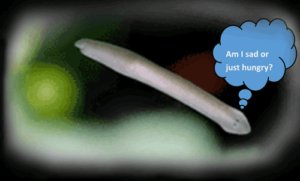
Planaria’s simple nervous system contrasts with Schopenhauer’s complex views on human consciousness and the will to life, but the lesson is the same:


The purpose of life is to stay alive

Opposing Points of View:

What is the purpose of life as seen though the eyes of three religions.

Aspect

 Core Purpose

Judaism

To praise and imitate God by striving for holiness, observing commandments (mitzvot), and repairing the world (tikkun olam). Humans are seen as partners in creation, with a focus on ethical living and communal responsibility as God’s “chosen people.”

Christianity

To love and serve God through faith in Jesus Christ, achieving salvation from sin, and glorifying God in daily life. Emphasizes a personal relationship with God, spreading the Gospel, and using free will for redemption.

Islam

To submit fully to Allah (tawhid), worship Him alone, and live righteously according to the Quran and Sunnah. Life is a test of faith and deeds, with the explicit goal of servitude to God (Quran 51:56: “I did not create jinn and humans except to worship Me”)

Key Scriptural Basis

Torah (e.g., Deuteronomy 6:5: “Love the Lord your God with all your heart”); emphasis on covenant and law.
Bible (e.g., Westminster Catechism: “Man’s chief end is to glorify God and enjoy Him forever”; John 17:3: eternal life through knowing God and Jesus).
Quran (e.g., 51:56 on worship; 67:2: life as a test to see who is best in deed)

Role of Humanity

Humans are created in God’s image to uphold justice, perform good deeds, and atone through repentance and rituals like Kapparot
Humans, flawed by original sin, are redeemed through Christ’s sacrifice; purpose includes loving neighbors and building God’s kingdom on earth.
Humans are vicegerents (khalifah) on earth, accountable individually without original sin; purpose involves good deeds, honesty, and universal submission.

Afterlife Orientation

Focus on righteous living for this world and the world to come (Olam Ha-Ba), with judgment based on deeds.
Eternal life in heaven through salvation; life prepares for judgment and union with God.
Life as preparation for Judgment Day (Yawm al-Qiyamah), with paradise (Jannah) or hell based on faith and actions.

Unique Emphasis

Communal and ethical repair; less proselytizing, more focus on Jewish covenant.
Redemptive grace via Jesus; missionary outreach to all nations.
Strict monotheism and submission; universal call, with five pillars structuring daily life


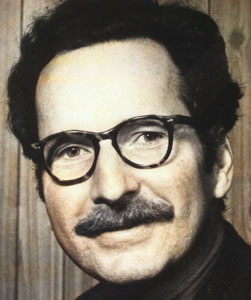
Ernest Becker Explains Religion’s Elaborate Narrative


Ernest_Becker (1924-1974)
Photo colorized from Wikipedia

Ernest Becker (1924–1974) was an American cultural anthropologist and interdisciplinary thinker best known for his works on human motivation, mortality, and the psychological roots of evil. Educated at Syracuse University, Becker served in World War II before earning his Ph.D. in cultural anthropology. His groundbreaking books,  The Birth and Death of Meaning (1962), The Denial of Death (1973, Pulitzer Prize 1974), and Escape from Evil (1975, posthumous),  explore how awareness of mortality shapes culture, religion, and human behavior. Deeply influenced by Freud, Kierkegaard, and Otto Rank, Becker argued that civilization is a symbolic defense against death anxiety. His ideas later inspired the field of  terror management theory , making him one of the most influential existential theorists of the 20th century.