

Please email questions to shalom@tov.com
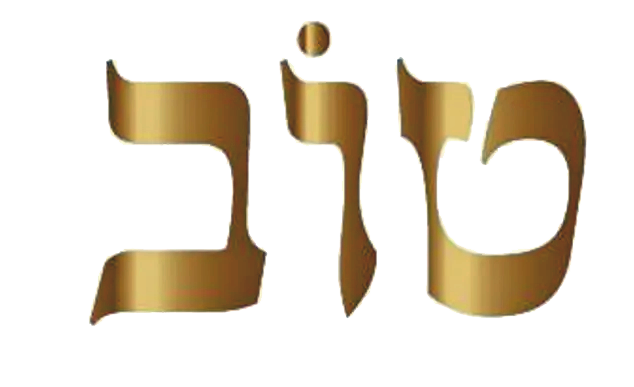
Read from right to left, TOV (טוֹב) is a rich and deeply meaningful Hebrew word that translates simply as “good” in English. It carries a broad range of everyday and biblical meanings, referring to things that humans regard as life-giving, morally excellent, or fulfilling the purpose for which they were intended.
Here we follow the journey of a word that traveled from antiquity through a language preserved for centuries in religious and literary use, then revived as the everyday language of a modern nation. It evolved from its biblical roots full of purpose and life, to a mundane everyday expression in Israel bordering on OK, good enough!
That’s OK, but it’s not good enough. We want to take you back to its roots and show that good deserves more than “Tov Ahi” (טוֹב אָחִי) — “Sure thing, bro”
Where did the idea of TOV come from? How do human beings decide what is good? Why do their answers differ so dramatically? And what happens when those answers are organized into religions, political doctrines, moral systems, and ideologies?
TOV is not something we discover by looking into space or through a microscope. The sounds, symbols, and meanings associated with the word emerged from human consciousness and were transmitted through language across generations.
The written forms that eventually produced Hebrew developed through the long history of alphabetic writing in the ancient Near East. Early alphabetic systems were fashioned by Semitic-speaking peoples who adapted elements of Egyptian writing into simpler signs representing speech sounds. Later Canaanite, Phoenician, Paleo-Hebrew, Aramaic, and Jewish scribal traditions carried those alphabetic forms forward until they developed into the Hebrew letters familiar today.
The ancient word that eventually became modern טוֹב / tov probably sounded substantially more forceful and guttural. A rough English approximation might sound like “TOHB”, but with a heavier, more forceful initial t and a final b, not the modern v.
The precise ancient pronunciation changed over time, as pronunciations always do. What matters here is more remarkable than phonetic reconstruction: an abstraction formed in human minds thousands of years ago can still be written, spoken, recognized, debated, and transmitted from one consciousness to another.
Language made that continuity possible. Without the human capacity to attach shared meanings to sounds and symbols, accumulated knowledge would disappear with each generation. Civilization depends upon our ability to preserve ideas outside a single human lifetime. George Santayana’s famous quote, “Those who cannot remember the past are condemned to repeat it,” suggests that humans don’t always learn from their mistakes.
If all we could do were bark like dogs, we would never have developed complex human civilization. Ignoring the bark, we can also learn from dogs. The ancient biblical proverb said it long before Santayana: “As a dog returns to its vomit, so fools repeat their folly.”
Consciousness extends far down the ladder of life. Mammals, birds, fish, reptiles, and even many insects respond to their surroundings in ways that imply perception, learning, memory, and preference. Human consciousness, however, developed an extraordinary additional capacity for symbolic language and the cumulative transmission of knowledge.
Language, music, mathematics, art, myth, religion, philosophy, science, and technology are products of that cumulative process. Knowledge passing from person to person across centuries has produced cities, universities, antibiotics, chemotherapy, aircraft, computers, and artificial intelligence.
Artificial intelligence as we call it exists objectively as hardware, software, stored information, and measurable computational processes. Whether machines can ever possess consciousness is a separate question.
Human consciousness creates a subjective world of beliefs, religions, philosophies, and ideologies that function as a set of internal roadmaps. Through them we construct meaning, establish values, interpret our experiences, and decide how human beings ought to live. We choose to group them all under the term “ideologies.”
Unlike the physical world, which is constrained by empirical facts and natural laws, ideologies, born from fertile human minds, are shaped by history, culture, psychology, experience, and choice. They make cooperation on an enormous scale possible, but they can also turn disagreement into conflict.
On balance, ideologies have gradually given us a more logical world of benign cooperation, but also one historically cursed by illogical malevolent conflict.
“The first principle is that you must not fool yourself and you are the easiest person to fool”
Richard Feynman – Cargo Cult Science – 1974
Richard Feynman – Cargo Cult Science – 1974
The word ideology in English evolved from the original French idéologie, meaning the “science of ideas.” Now it has become a catch-all phrase for ideas, beliefs, doctrines, philosophies, worldviews, and dogmas that people adopt to understand the world and guide their lives. Some also seek to impose those beliefs on others.
Politically, ideologies include systems such as liberal democracy, constitutionalism, socialism, communism, nationalism, libertarianism, and theocracy. Socially and morally, they include beliefs about culture, equality, fairness, rights, obligations, religion, family, and the relationship between the individual and the community. Cultural, religious, philosophical, economic, and other ideologies combine within individual lives to form broader worldviews — internal roadmaps for navigating reality.
The problem is not that human beings possess ideologies. We could not organize complex societies without shared ideas. Ideologies can inspire abolition of slavery, constitutional government, toleration, scientific inquiry, philanthropy, and human rights. They can also justify theocracy, dictatorship, religious persecution, political terror, and mass murder.
Human beings are bound by physics and biology, but our ideologies are not physical laws. They are products of consciousness, history, ethical judgment, and institutional development. They are never perfectly logical or internally coherent, and no ideology is made true merely because millions of people believe it.
Logic and coherence are related but not identical. Logic supplies rules for valid reasoning and avoiding contradiction. Coherence asks whether the parts of a worldview fit together and support one another. Neither tells us whether an ideology produces a society in which human beings flourish.
That requires another test. To the extent that an ideology is life-giving, reduces unnecessary suffering, protects human agency, encourages cooperation, and allows people to fulfill constructive purposes, we may reasonably call its consequences good. When an ideology systematically produces needless suffering, coercion, degradation, or destruction, we encounter what human beings have long called evil.
The “Problem of Good and Evil,” frequently called the Problem of Evil, is the philosophical and theological puzzle of how to reconcile the reality of suffering and wickedness in the world with the idea of a God who is all-knowing, all-powerful, and completely good. If God can stop evil and wants to stop evil, why does evil still exist?
Theodicy is the branch of philosophy and theology that attempts to defend God’s goodness and power in the face of suffering and evil. Historically, religion is one reason people have waged war against each other. Can killing be part of God’s plan? It is a question we cannot answer.
For our purposes, however, we can set the theological question aside. Removing theodicy from the immediate discussion does not eliminate evil, but it makes the problem more tractable: we can examine suffering, coercion, destruction, and human flourishing without first deciding what God permits or intends.
Without a divine judge, good and evil can be redefined through human experience, biology, and social survival.
Totalitarian communist/Marxist-Leninist ideologies have historically inflicted the largest scale of organized intentional, unnecessary suffering and death, followed by fascist/Nazi ethno-nationalism, with militant Islamism and jihadist ideologies currently producing the most concentrated ongoing intentional violence against civilians. These patterns emerge from democide data (government murder of civilians outside battlefield deaths), war-related excess deaths tied to ideology, and terrorism statistics rather than from abstract moralizing.
In the 21st century the largest ongoing sources of intentional civilian suffering tied to ideology are Islamist movements and regimes. Jihadist groups (Islamic State and affiliates, Taliban, Boko Haram, Al-Shabaab, Al-Qaeda networks, Hamas and Hezbollah, etc.) have driven the majority of global terrorism deaths for years. According to the 2026 Global Terrorism Index, Islamic State, JNIM, Tehrik-e-Taliban Pakistan and al-Shabaab together accounted for approximately 70 percent of all terrorism deaths worldwide in 2025.
Theocratic or Islamist-authoritarian states (Iran’s export of revolutionary ideology and proxies, Taliban Afghanistan, elements of Sudanese and Sahel conflicts) combine governance by rigid religious law with deliberate targeting of minorities, apostates, women under certain interpretations, and political opponents. Practices such as public executions, slavery (ISIS), forced conversions, and systematic sexual violence meet the definition of intentional unnecessary suffering.
Related ethno-religious conflicts (parts of the Sahel, Nigeria, Yemen, Syria) frequently feature Islamist framing that elevates group purity or apocalyptic goals over minimizing civilian harm.
The ideologies that generate the most evil share structural features more than specific theological or economic content. Utopian or eschatological claims justify present suffering as the price of a perfected future, whether a classless society, pure race, caliphate, end-times purification, or Ayatollah Khomeini’s Twelver Shiite Eschatology. Political ideologies employ violence without religious justification.
Fanatical variants of fascism, communism, and religious fundamentalism have been responsible for some of the largest episodes of ideologically motivated mass violence in modern history. Ordinary human vices (greed, tribalism, status-seeking) exist everywhere; ideologies amplify them by providing moral permission and organizational capacity for industrial-scale or systematic infliction of suffering.
Industrial-scale capabilities are what made the Islamic Republic of Iran so dangerous, not only in the Middle East, but to the world in general. They declared the West to be the great Satan and Israel the little Satan, and have vowed the destruction of both.
If morality is interpreted through human consciousness rather than imposed by an unquestionable divine or ideological authority, a difficult problem remains: by what standards can one society be judged better than another?
Perfection cannot be the standard. No nation is free of injustice, bad leaders, prejudice, corruption, war, or tragic mistakes. A more useful test is whether a society contains institutions that reduce the damage human beings can do to one another and mechanisms that allow errors to be exposed and corrected without destroying the society itself.
A good society therefore protects the individual against arbitrary power. It recognizes some sphere of conscience, speech, religion, property, association, and private life that neither the majority nor the government may casually invade. It subjects rulers to law, permits political opposition, provides peaceful mechanisms for replacing leaders, and allows citizens to criticize the institutions under which they live.
It also makes disagreement survivable. People of different religions, ethnicities, political parties, and moral traditions do not need to agree about ultimate truth in order to cooperate. They need rules that allow them to pursue different visions of the good while restraining them from imposing those visions on others through force, fraud, intimidation, or arbitrary state power.
Such a society will still argue bitterly. Indeed, visible disagreement can be evidence of freedom rather than decay. Courts will reverse governments, newspapers will condemn leaders, voters will remove parties from office, demonstrations will fill the streets, and citizens will accuse one another of being profoundly wrong. The essential question is whether those conflicts are processed through institutions instead of through systematic political violence.
Finally, a good society creates conditions in which knowledge, enterprise, science, education, medicine, culture, and voluntary cooperation can flourish. Its institutions are valuable because they allow millions of fallible people to learn, create, exchange, disagree, correct mistakes, and improve their lives.
By these standards, the nations of Western Europe clearly qualify, as do their cultural offspring including former colonies. The modern State of Israel emerged in 1948 with political and legal institutions substantially shaped by the democratic and constitutional traditions of the West, while maintaining a distinctly Jewish national identity. Despite romantic notions of restoring a homeland for a persecuted religious minority, the creation of the modern State of Israel was a rational political enterprise yielding immense benefits for the West, fulfilling optimistic expectations since then, and continuing to carry Western Values in the on-going battle of ideologies.
While the Hebrew language in Israel serves to build a single shared identity from an extraordinarily diverse immigrant population, the widespread knowledge of English binds them together and opens Israel up to intimate cooperation with the West. In fact, English has effectively become the de facto shared language (or lingua franca) of the entire West and the wider world.
The test of a society is not whether it claims to be good. The test is what happens to human beings when they live under its rules.
Based on the Cato Institute’s current Human Freedom Index, the United States ranks number 15, while Israel is number 57. It sounds like a large difference, but 15 and 57 are just the order in which the two countries fall, not the magnitude of the distance between them. Likewise the United States is only marginally less “free” in Cato’s ranking than number one Switzerland.
If good and evil are products of human judgment, does that mean that every ideology is equally valid and that every society is merely different from every other?
No.
We can judge an ideology by what happens when human beings attempt to live under it. Does it protect life or casually sacrifice it? Does it permit people to think, speak, worship, create and disagree? Does it restrain the power of government? Does it allow peaceful political opposition? Does it encourage cooperation and human flourishing, or does it divide humanity into believers and infidels, rulers and subjects, approved classes and condemned ones? Cato’s Human Freedom Index offers a rational way to judge.
No nation is perfectly good. Certainly, neither the United States nor Israel is perfect. Both countries are divided politically. Both have committed errors. Both contain citizens who passionately disagree about religion, government, war, immigration, economics and the meaning of justice itself.
Israel struggles successfully with divergent internal ideologies, gives voice to them all, and emerges prosperous.
Americans can condemn an American president. Israelis can condemn an Israeli prime minister. Governments can be challenged in court. Newspapers can attack national policy. Religious believers, atheists, conservatives, liberals, socialists and capitalists can compete publicly for the allegiance of their fellow citizens. Politicians come and go while the nation survives.
It is evidence of something extraordinarily valuable: people are permitted to disagree.
That is a radically different conception of political life from an ideology in which government, party, religious authority or revolutionary movement possesses an unquestionable truth and may silence those who reject it. Israel is surrounded by such nations.
Cato ranks them: Among regional Middle Eastern comparisons, Jordan ranks 94; Kuwait 113; Lebanon 117; United Arab Emirates 121; Oman 122; Qatar 128; Bahrain 129; Turkey 144; Saudi Arabia 148; Iraq 150; Libya 156; Egypt 160; Yemen 162; Iran 164; Syria 165. The list ends with Syria currently last at number 165. There is no ranking for Gaza, which is not a nation state because they have consistently refused a two state solution. Freedom House does assess Gaza separately as a territory and, in its 2026 report, rates it “Not Free,” with a Global Freedom score of 2 out of 100.
Why Is There Such a Large Ranking Gap Between Two Good Societies?
Hebrew never disappeared. After it ceased to be an everyday vernacular, it continued for centuries in prayer, scholarship, literature, and communication. Beginning in the late nineteenth century, Hebrew revivalists transformed it once again into a language of ordinary daily speech. The establishment of Israel gave that revival the institutions and scale of a modern national language, returning ancient words such as טוֹב to everyday conversation.
Israel declared its independence on May 14, 1948, mirroring American’s Declaration of Independence in 1776, but sounding more like a legal brief than a grand declaration. Following the declaration, the new government enacted the Law and Administration Ordinance of 1948, which formally retained Hebrew and Arabic as the nation’s official languages.
The Declaration stated its purpose:
THE STATE OF ISRAEL will be open for Jewish immigration and for the Ingathering of the Exiles; it will foster the development of the country for the benefit of all its inhabitants; it will be based on freedom, justice and peace as envisaged by the prophets of Israel; it will ensure complete equality of social and political rights to all its citizens irrespective of religion, race or sex; it will guarantee freedom of religion, conscience, language, education and culture; it will safeguard the Holy Places of all religions; and it will be faithful to the principles of the Charter of the United Nations.
And then appealed for peace:
WE APPEAL – in the very midst of the onslaught launched against us now for months – to the Arab inhabitants of the State of Israel to preserve peace and participate in the upbuilding of the State on the basis of full and equal citizenship and due representation in all its provisional and permanent institutions.
The Land of Israel and the State of Israel overlap in the minds of many people but only the State of Israel operates with a parliament (the Knesset), a prime minister, a standing military, defined international borders, and a system of civic and constitutional law. It functions within international law, holding formal citizenship, treaties, and diplomatic relations, entirely separate from ancient theocracies or purely religious definitions of the land.
Despite over 70 years of almost continual conflict imposed upon it by neighboring states, the State of Israel has achieved remarkable economic strength. Its citizens enjoy a GDP per capita exceeding $60,000 USD, placing it on par with wealthy Western nations.
Commentators often point to Israel’s robust agricultural achievements (e.g., turning the desert green) and its technological and medical innovations as the literal manifestation of TOV—generating Life-Giving Material Success, practical utility that benefits both its citizens and the wider world.
We welcome thoughtful essays or comments, possibly for publication on this site.