


Objective truth exists even when human access to it is incomplete. Trust can cease to exist in an instant.
Here we explore what two major thinkers have said about truth and trust, and how the two are related.
In his final major work, Truth and Truthfulness: An Essay in Genealogy, Bernard Williams argues that liberal democracy is deeply dependent on the virtues of truth—specifically accuracy and sincerity—to limit state power, protect individual liberty, and prevent tyranny. Williams applies his philosophical defense of truth to politics and modern liberalism through several key arguments. He does not offer a novel formal or metaphysical definition of truth; instead, he takes truth as an objective state of affairs or facts that is independent of our wishes, beliefs, or cultural perspectives.
Rather than dissecting abstract epistemic definitions of what makes a proposition true, Williams focuses on truthfulness: how a commitment to truth functions as a cultural and ethical value.
The Core Distinction: Truth vs. Truthfulness
Truth is the way things actually are in objective reality, or material existence. Williams presupposes a reality that exists independently of our wishes, beliefs, and ideologies.
Truthfulness, on the other hand, is a practical and moral orientation toward that reality. Williams divides the general disposition of truthfulness into two concrete, interdependent intellectual virtues. Accuracy is the active, disciplined drive to find out the truth and investigate reality without letting personal wishes, ideology, or self-deception distort our findings. Sincerity is the pro-social commitment to tell the truth and communicate what one genuinely believes to others, avoiding lies and deliberate deceit.
Williams’ concept of "unmasking" flows directly from his exploration of accuracy and sincerity. The "unmasking process" describes the modern phenomenon where people use severe skepticism to strip away comforting myths, biases, and ideological illusions. Williams argues that this relentless drive to unmask is actually an intense exercise of Accuracy. The critic wants so desperately to avoid being deceived that they demand absolute factual and historical clarity.
This creates a profound structural tension. In its zealous quest to unmask everything, modern critique (influenced heavily by Nietzschean genealogy and postmodern thought) eventually focuses on the concept of "objective truth" itself. By arguing that all claims to truth are merely hidden plays for power, social constructs, or psychological coping mechanisms, the unmasking process accidentally destroys the foundation required for Sincerity. If there is no objective reality to anchor our beliefs, "telling the truth" ceases to have any real meaning. Williams warns that when the unmasking process is allowed to run completely unconstrained, Accuracy ends up devouring Sincerity. The desire to be ruthlessly truthful deconstructs the very possibility of truth, leaving society in a state of cynical nihilism.
To understand why Williams’ “cynical nihilism” has not completely frozen modern society in place, it helps to look at how social and political dynamics actually play out across generations. Williams was right about the intellectual trap: if you ruthlessly unmask everything as a power grab, you eventually unmask your own ability to speak the truth.
However, generations do not live in abstract philosophy; they live in material and social reality. Nihilism is rarely abolished by an intellectual argument; rather, it is outgrown because nihilism is structurally unsustainable for human survival and psychological well-being. Succeeding generations quickly realize that pure skepticism offers no practical tools for building things. To solve complex problems (such as pandemics, economic crises, and engineering problems), younger generations are forced to re-adopt the virtue of Accuracy. In practical life, survival repeatedly forces a return to facts.
The Myth of the Transparent Society
While Williams defends liberalism, he rejects the naive Enlightenment view that politics can ever be entirely transparent or perfectly rational. He recognizes that politics inherently involves compromise, myth-making, and structural secrecy. A completely transparent society is a utopian fantasy. The goal of a liberal society is not to eliminate all political deception, but to maintain robust, institutionalized demands for truthfulness so that exercises of power must constantly justify themselves to the public.
Williams views liberalism as a historically contingent cultural arrangement. Because it is a product of history rather than a law of nature, it is fragile. He argues that if liberal cultures lose their passion for Accuracy (finding out the facts) and Sincerity (speaking the truth), the very foundation of trust required for a free, pluralistic society will dissolve, risking personal and political ruin.
Trust
Williams brings us from truth to truthfulness. Francis Fukuyama supplies the next step: what happens when repeated expectations of honesty, reliability, and shared norms become social trust? In his seminal 1995 book, Trust: The Social Virtues and the Creation of Prosperity, Francis Fukuyama argues that a nation’s economic well-being, competitive strength, and social stability depend directly on its level of "social capital," defined as the cultural prevalence of mutual trust. Fukuyama challenges traditional economic theories that view humans purely as rational, self-interested actors. Instead, he asserts that the most prosperous societies rely heavily on unwritten moral habits, shared ethical norms, and spontaneous sociability to form efficient, large-scale networks without heavy state intervention or suffocating legal frameworks. His later work broadens this account: trust remains important, but durable liberal order also depends on capable institutions, the rule of law, political accountability, and an inclusive civic identity.1
The Core Thesis: High-Trust vs. Low-Trust Societies
High-Trust Societies (e.g., Japan, Germany, and historically the United States) are cultures that possess a high degree of generalized trust extending beyond immediate family units. This allows them to build vast, flexible, privately owned corporations (like Toyota or Siemens) run by professional managers rather than family heirs. Because people trust strangers to honor agreements, business transaction costs are low, and collaboration is highly efficient. Low-Trust or Familistic Societies (e.g., China, southern Italy, France) are cultures in which trust is highly concentrated within close-knit kinship networks. People are fiercely loyal to their families but highly suspicious of outsiders. Consequently, private businesses struggle to scale up beyond family-managed size because owners refuse to cede authority to outside professionals. To build massive national infrastructure or industries, these societies must rely more heavily on a centralized state.
What Kind of Trust?
The word trust covers several related but distinct relationships. Interpersonal trust concerns particular people; generalized social trust extends to strangers; institutional trust concerns courts, media, schools, businesses, and other organizations; political trust concerns governments and public authority. Fukuyama’s argument is strongest when trust extends beyond kinship and tribe into a broad radius of generalized cooperation. Not all trust is good: criminal organizations, corrupt patronage networks, and extremist groups can display intense internal trust. A free society needs bridging trust across groups, reinforced by rules that apply beyond personal loyalty.
Connecting Truth to Trust
A rational progression is Physical Reality → Truth → Accuracy and Sincerity → Reliability → Trust → Cooperation → Freedom. Each step depends on the preceding one, although the relationship is not strictly linear: free institutions can also reinforce trust by making power predictable and subject to verification.
Accuracy is disciplined truth-seeking; Sincerity is honest communication. Neither alone makes a person or institution trustworthy. Trust develops when truthfulness is joined by competence, consistency, and a demonstrated willingness to follow shared rules.
This progression also helps explain why quantitative indexes can compare institutional conditions associated with human freedom. The Human Freedom Index does not measure trust directly. It measures conditions such as rule of law, security, expression, association, property rights, and economic choice. Those conditions are difficult to sustain without social trust: confidence that strangers will generally cooperate, that institutions will apply rules predictably, and that government will remain constrained by law. Williams helps explain the virtues that make truthful cooperation possible; Fukuyama shows how repeated cooperation becomes social capital; measures such as the Human Freedom Index show some of the institutional consequences when those relationships succeed.
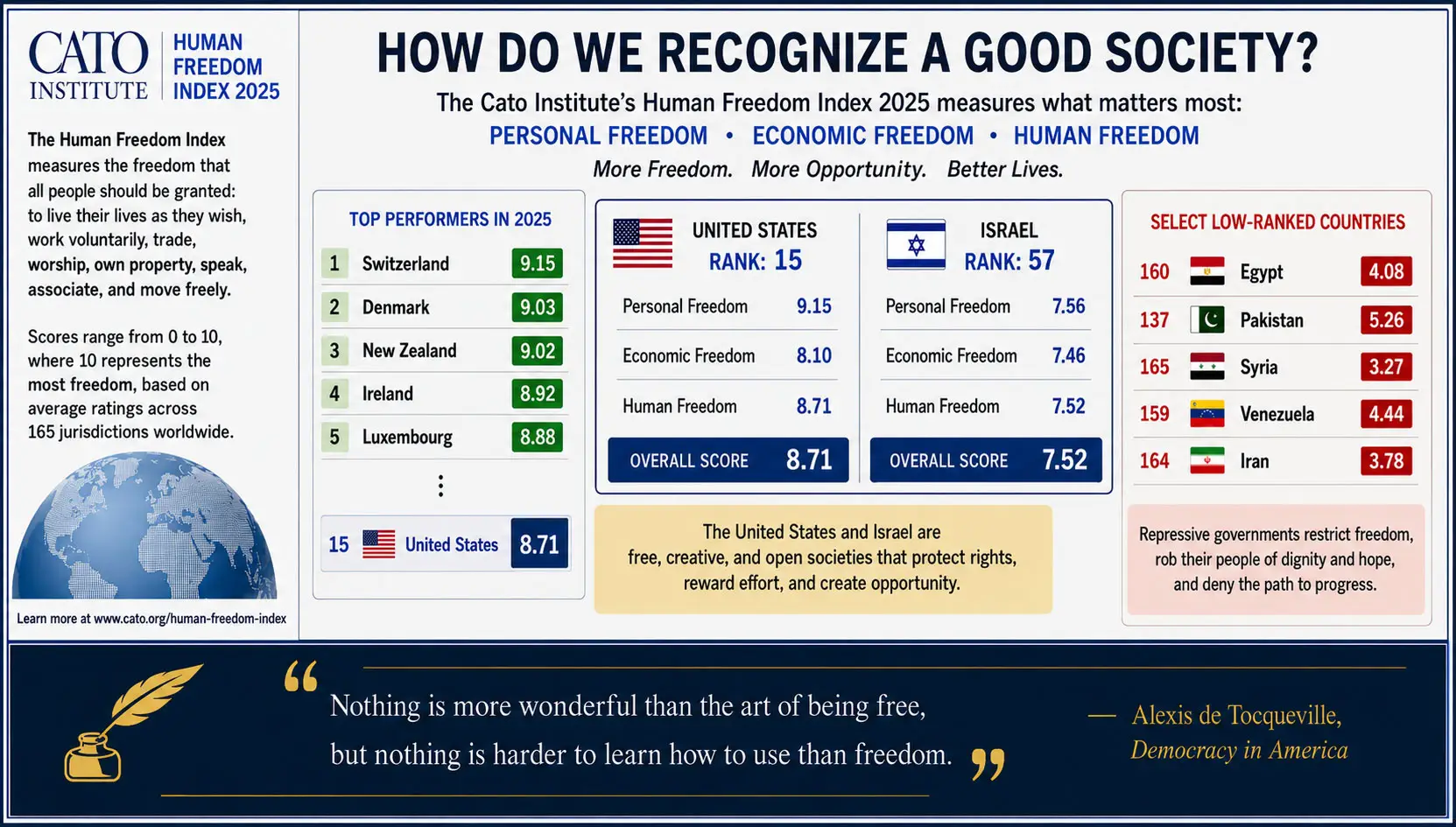
Trust, Verification, and Freedom
A free society does not require blind trust. Liberal institutions are designed around the opposite assumption: people and governments are fallible and sometimes untrustworthy. Courts, elections, contracts, audits, due process, a free press, scientific replication, and divided political power institutionalize verification. Citizens can extend trust beyond family and tribe partly because they know that strangers and officials operate within enforceable rules.
Freedom therefore depends on both trust and institutionalized distrust. Social trust lowers the cost of cooperation, while constitutional limits make trust safer by restricting what any person or office may do. Trust supports freedom, but predictable freedom-supporting institutions also create trust. The relationship runs in both directions.
When a society loses confidence in truthfulness and interpersonal reliability, it compensates with formal verification: explicit disclosures, audits, surveillance, compliance rules, algorithms, and increasingly detailed legal codes. Such mechanisms are necessary in complex societies, but no amount of formal verification can fully substitute for social trust. Once social capital erodes, the costs of cooperation rise and the institutions of both a competitive market and a functional democracy begin to fray.
American Social Trust Has Declined
Fukuyama details the breakdown of American social capital in his follow-up work, The Great Disruption: Human Nature and the Reconstitution of Social Order. He observed that between the early 1960s and the 1990s, the United States moved away from the unusually high levels of social cohesion that characterized much of the postwar period toward a more atomized and suspicious social order.
The Transition to an Information Economy
The mid-20th century marked the end of the industrial age and the rise of the information society in the United States. While this brought massive economic prosperity, it fundamentally glorified individualism over community. Industrial society required mass collaboration, large factories, union memberships, and predictable neighborhoods. The information economy, by contrast, prioritizes individual talent, hyper-mobility, and cognitive independence. This economic liberation fragmented the geographical and communal networks that previously forced ordinary Americans to cooperate with strangers.
The Collapse of the Nuclear Family and Social Integration
Fukuyama argues that social trust is a habit learned first in private life. Starting in the 1960s, the West saw a dramatic rise in divorce rates, single-parent households, and declining birth rates. As the traditional family structure fractured, the baseline stability of children's upbringing altered. Simultaneously, people began dropping out of local community structures, churches, bowling leagues, PTA groups, and Rotary Clubs. This shrank what Fukuyama calls the "radius of trust." Even if people still interacted with others, those social ties became fleeting, superficial, and less binding.
The Shift from "Bridging" Trust to Tribal "Bonding" Trust
Historically, American civic life often encouraged bridging trust: people could work with strangers toward common goals, a trait Alexis de Tocqueville famously observed in the 1830s. Robert Putnam later popularized the distinction between bonding social capital, which strengthens ties within a group, and bridging social capital, which connects people across groups. In the latter half of the 20th century, many Americans increasingly organized themselves into tightly bonded but mutually suspicious factions. Identity politics, polarization, and internet echo chambers can intensify that pattern. Americans therefore need not stop trusting altogether; trust can become narrower, stronger within the internal group, and weaker across group boundaries.
The Modern Result: Institutional Paralysis
Fukuyama emphasizes that a cultural loss of trust can paralyze democratic institutions. When citizens distrust one another and lose confidence in courts, the media, scientists, elections, or government agencies, ordinary political disagreement can harden into systemic suspicion. Low generalized trust raises the cost of governing and makes gridlock easier to interpret as evidence that institutions are incompetent, captured, or deliberately hostile.
The Immigration Dilemma
Fukuyama's framework can also be applied to immigration, although the following argument extends beyond the claims of Trust itself.
In Fukuyama’s later framework, immigration does not inherently destroy trust; its effects depend heavily on whether institutions and a shared civic identity can integrate newcomers into a common political community.2
First published in the Journal of Democracy (and later widely distributed as the adapted essay "Identity and Migration"), this text directly bridges his 1995 book Trust with his modern work on polarization.
In this writing, Fukuyama warns that modern Western societies have developed a "postmodern elite" culture that views traditional national identities as obsolete. Because these societies can no longer articulate their own positive liberal values, they struggle profoundly to assimilate newcomers. When continuous waves of immigration enter a society that lacks the institutional confidence to assimilate them into a shared civic creed, it accelerates the formation of isolated "parallel societies," fragmenting the overarching baseline of social trust.
Dearborn, Michigan, is historically known as the “Capital of Arab America.”
In France, Seine-Saint-Denis is plagued by high unemployment and poverty. The French press and politicians frequently label these areas as "lost territories of the Republic" (les territoires perdus de la République), where secular French state laws (laïcité) clash directly with conservative religious customs.
The borough of Neukölln in Berlin is often cited in debates over Germany’s Parallelgesellschaften, or “parallel societies.” German authorities have also confronted informal community mechanisms for resolving disputes outside ordinary courts, sometimes described in the German debate as “shadow justice.”
Fukuyama links this phenomenon with the decline of America’s own internal "assimilative machinery." He explains that immigration acts as a catalyst for distrust today in ways it did not during previous historic waves due to several critical shifts.
America’s Broken Assimilative Machinery
Social trust relies on shared, predictable cultural norms. In the past, the U.S. operated with a wide "radius of trust" that allowed different groups to find common civic ground. Today, as modern immigration introduces highly diverse cultural frameworks into an already polarized America, it collides with a host society that has lost its own unified identity. Rather than bridging differences, both immigrant communities and native-born factions tend to retreat into defensive, low-trust "bonding" networks (tribalism), treating outsiders with suspicion.
Because baseline trust in institutions such as the media, government, and the judiciary is already low, immigration can be weaponized by political entrepreneurs. Cynical actors use high immigration numbers to fuel conspiracy theories, including claims that the state is deliberately changing the electorate. The immigration debate can then cease to be a policy argument and become an existential struggle over identity, further eroding trust in the state.
Work Was Spontaneous Sociability
Historically, work was a primary site for “spontaneous sociability,” where people of different backgrounds joined unions, worked assembly lines, and built mutual reliance. Immigrants often learned English through workplaces, schools, neighborhoods, and civic institutions. What has changed is not the need for economic cooperation but the structure of many workplaces and communities in which that cooperation once occurred.
The modern information economy separates labor into hyper-stratified tiers. High-skilled tech immigration and low-skilled manual labor immigration often happen in parallel, segregated tracks. Because these groups rarely interact in shared, egalitarian spaces, the economic structure no longer fosters organic trust between demographic layers.
Why Trust Didn't Collapse During Previous Immigration Waves
When millions of Irish, Italian, German, and Eastern European immigrants arrived in the 19th and early 20th centuries, their arrival produced severe nativist friction. Yet those waves did not permanently destroy American social capital. Several features of the period helped later generations build broader trust.
During previous waves, the American host culture possessed a strong and widely shared civic creed based on constitutional government, the rule of law, and civic duty. The expectation was assimilation into this shared political identity.
Today, Fukuyama notes that the West has drifted into what he calls the "valuelessness of postmodernity." Because elite mainstream culture now celebrates endless diversity and tolerance without defining the substance of a shared national identity, it cannot offer incoming immigrants a cohesive framework to integrate into. When a society doesn't know who it is, it cannot build trust with newcomers.
When early 20th-century immigrants arrived, America was densely populated with civic infrastructure. Immigrants and native-born citizens alike were pulled into powerful intermediate institutions: labor unions, local political machines, neighborhood churches, fraternal orders, and public schools. These institutions acted as trust factories, actively blending disparate populations and teaching them the habits of cooperation. Today, those intermediate institutions have largely collapsed, leaving nothing to facilitate that vital social cross-pollination.
Previous massive influxes of immigration were followed by sharp legislative pauses, most notably the Immigration Act of 1924, which severely restricted immigration for four decades. Although the law was driven in substantial part by nativism and discriminatory national-origins preferences, the resulting pause had the incidental sociological effect of giving the children and grandchildren of earlier immigrants more time to integrate, intermarry, and participate in shared institutions. Modern immigration following the Immigration and Nationality Act of 1965 has been far more continuous, placing different demands on a host society whose own civic institutions have weakened.
Europe’s Turbulent Experience
We are reminded of George Santayana’s quote: “Those who cannot remember the past are condemned to repeat it.” — but with a twist: “Those who cannot learn from current events are condemned to live with the consequences.” History does not repeat itself mechanically, and the social conditions in which human beings form trust are changing rapidly in the digital age. We may no longer have the luxury of waiting generations for historical lessons to become obvious; error correction increasingly has to occur in real time.
What can be learned from contemporary European experiments in immigration, secularism, national identity, assimilation, and social integration?
The table below compares several structural challenges to trust and integration in the United States, France, and Germany:
| Nation | Nature of Identity | The Core "Integration Failure" | Political Backlash |
|---|---|---|---|
| United States | Creedal & Ideological | The failure of economic safety nets and the gutting of civic institutions leave modern immigrants and working-class natives isolated, fueling mutual cultural resentment. | Anti-system populism that shifts focus from economics to border security and "tribal" defense. |
| France | Assimilationist & Secular | Strict secularism (laïcité) demands total public assimilation, but the state fails to provide equal economic mobility, creating a geographic ghettoization of minorities. | Intense identity friction, polarization over public religious symbols, and the rise of hyper-nationalist parties. |
| Germany | Historically Ethnic | Historically based on blood descent, Germany relies on a generous welfare state rather than labor markets for integration, fostering dependency and "parallel societies". | Aggressive pushback against humanitarian refugee intakes, triggering a sharp polarization over the definition of German culture (Leitkultur). |
Truth and trust are related, but they are not the same thing. Truth describes reality whether anyone accepts it or not. Truthfulness is a human practice: the effort to discover reality accurately and communicate what we believe sincerely. Trust arises only after those practices prove reliable over time.
A falsehood can be trusted, sometimes by millions of people, and a truth can be rejected. Trust therefore cannot certify truth. Yet durable social trust becomes difficult when people routinely lie, institutions conceal error, or competing groups cease to recognize any common standard by which claims can be tested. Williams explains why Accuracy and Sincerity are indispensable virtues; Fukuyama shows what societies can build when people expect those virtues from one another.
Truth is elusive because our knowledge is incomplete. Trust is fragile because it depends on other human beings. Neither can be commanded into existence. Truth must be sought and tested; trust must be earned and repeatedly renewed. A society can survive disagreement. It has much greater difficulty surviving when its members no longer believe that there is a reality worth discovering or anyone outside their own group worth trusting
Notes
Fukuyama’s later political-order work places greater weight on institutions than Trust (1995) alone might suggest. In The Origins of Political Order (2011) and Political Order and Political Decay (2014), he describes modern liberal democracy as a balance among an effective state, the rule of law, and political accountability. His later position therefore supplements rather than simply abandons the importance of social trust.↩︎
Fukuyama’s later writing on national identity also qualifies a simple homogeneity-versus-diversity account. In “Why National Identity Matters” (Journal of Democracy 29, no. 4, 2018), he argues that an inclusive national identity built around liberal and democratic values can foster trust among citizens and help diverse societies sustain liberal democracy.↩︎