

The phrase “labor camp” is one of the great euphemisms of the Nazi era. Some Nazi camps were indeed designed around forced labor, but forced labor itself was often a method of murder. Prisoners were worked until they collapsed, starved, beaten, shot, medically abused, transported in sealed railcars, or selected for gassing when they could no longer be exploited. Other camps were not labor camps in any meaningful sense. They were extermination centers: places built for the rapid, systematic killing of human beings, especially Jews, but also Roma, Soviet prisoners of war, Poles, disabled people, and others whom the Nazi state defined as racial, political, or biological enemies.
A literal list of every Nazi camp where Jews and others were murdered would run into the thousands. Historians now identify tens of thousands of Nazi detention, labor, concentration, ghetto, transit, prisoner-of-war, and killing sites across German-occupied Europe. The most important distinction is therefore not between “labor camp” and “death camp,” but between different functions inside a single system of persecution. The principal extermination centers were Chełmno, Bełżec, Sobibór, Treblinka, and Auschwitz-Birkenau. Majdanek, near Lublin, was formally a concentration and forced-labor camp, but it also contained gas chambers and was used for mass murder. Beyond these, major concentration camps such as Dachau, Mauthausen, Sachsenhausen, Buchenwald, Bergen-Belsen, Ravensbrück, Neuengamme, Flossenbürg, Gross-Rosen, Stutthof, Natzweiler-Struthof, and Mittelbau-Dora became places where enormous numbers died from starvation, disease, executions, medical experiments, death marches, and forced labor.
The geography of the Nazi murder installations was not accidental. The extermination centers were located mainly in occupied Poland, near rail lines, away from the German public, and close to the large Jewish populations of Poland and eastern Europe. The railway was the circulatory system of the Holocaust. Deportation trains carried Jews from ghettos, cities, transit camps, and occupied countries to killing centers. The victims were usually told they were being “resettled,” “disinfected,” or sent to work. In many cases, families were permitted to bring luggage, clothing, religious objects, and household goods, precisely to maintain the deception until the last possible moment.
Chełmno (Kulmhof in German) was the first fixed Nazi killing center to use poison gas for mass murder. It was located near the village of Chełmno nad Nerem, northwest of Łódź, in territory annexed to the German Reich. Its location linked it to the Łódź ghetto and to rail routes leading to Koło, from which victims were moved onward by local transport. Chełmno did not operate like the later Reinhard death camps with large permanent gas chambers. Its killing technology was the gas van. Victims were forced into sealed vans. The engine exhaust, rich in carbon monoxide, was redirected into the cargo compartment. After the victims suffocated, the vans drove to the nearby Rzuchów forest, where bodies were buried in mass graves and later exhumed and burned when the Germans tried to destroy evidence. Approximately 156,000 people were murdered there, including approximately 156,000 Jews and several thousand Roma.1
Bełżec lay in southeastern Poland, near the railway between Lublin and Lwów, close to the village of Bełżec. It became the first of three killing centers named Operation Reinhard (Einsatz Reinhard), the code name for the murder of the Jews of the General Government. Lublin District (Distrikt Lublin) was one of the administrative districts of the General Government, an area home to about 2 million Jews, the territory in Poland occupied by the Nazis from 1939 to the end of the war in 1945.
Its location was ideal for murder disguised as a transit or labor operation: trains could arrive from ghettos across the region, and the camp was small enough to be hidden behind fences, branches, and controlled zones. Victims were unloaded, told to undress, and forced through a fenced passage known as the “tube” toward gas chambers disguised as showers. Carbon monoxide generated by an engine was pumped into the chambers. The bodies were first buried in mass graves. Later, as the Germans understood that defeat might expose the crime, corpses were dug up and burned on open-air pyres. Roughly 435,000 Jews were murdered at Bełżec, but one should note that estimates vary slightly across historians.2 Only a tiny number survived, which is one reason it remains less well known than Auschwitz despite its enormous death toll.
Sobibór, another Operation Reinhard camp, was located in a wooded, swampy region east of Lublin, near the Sobibór railway station and not far from the Bug River. Like Bełżec, it was built not as a conventional prison but as a machine for killing deportees arriving by rail. Trains were divided into sections and moved toward the camp. Victims were told they had arrived at a transit or work site and needed to bathe and be disinfected. Their possessions were taken, hair was cut from women, and they were driven through the narrow passage to gas chambers. Carbon monoxide was again the killing agent. The ill, elderly, or unable to walk could be shot immediately. The bodies were buried in pits and later burned on open-air grates made partly from railway tracks. At least 167,000 Jews were murdered there. Sobibór is also remembered for the prisoner revolt of October 1943, when Jewish prisoners killed several SS men and escaped. Most escapees were later hunted down, but the revolt forced the Germans to dismantle the camp.
Treblinka was the deadliest of the Operation Reinhard camps. It was built northeast of Warsaw, near the village of Treblinka and the railway junction at Małkinia Górna, which linked routes from Warsaw, Białystok, Siedlce, Lublin, and other centers. Treblinka I was a forced-labor camp; Treblinka II was the extermination center. Its rail spur allowed deportation trains to be brought directly to the killing site. The Warsaw ghetto, after months of starvation and terror, became one of Treblinka’s main sources of victims. As at Bełżec and Sobibór, the process was choreographed for speed: arrival, separation, undressing, deception, forced movement through the “tube,” gassing with carbon monoxide, removal of bodies, extraction of valuables, and disposal in pits or pyres. Approximately 925,000 Jews were murdered at Treblinka, along with smaller numbers of Roma, Poles, and Soviet prisoners. It was, in human terms, one of the most concentrated sites of murder in history.3
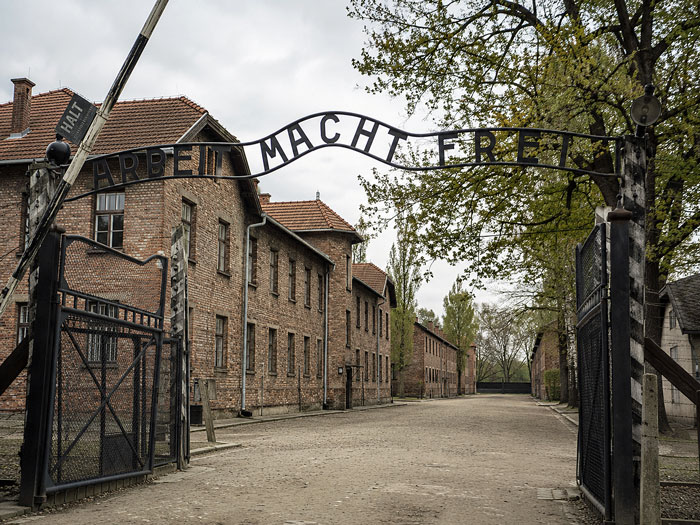
Auschwitz-Birkenau was different in scale, complexity, and symbolism. Located near Oświęcim in annexed Polish territory, about thirty miles west of Kraków and connected to the broader Silesian industrial and railway network, Auschwitz was a camp complex rather than a single camp. Auschwitz I was the original concentration camp. Auschwitz II-Birkenau became the principal killing center. Auschwitz III-Monowitz was tied to industrial forced labor, especially the I.G. Farben synthetic rubber and fuel complex. Around these were many subcamps. Its rail connections made Auschwitz accessible from much of Europe: Jews were deported there from Poland, Hungary, France, the Netherlands, Greece, Belgium, Germany, Austria, Italy, Slovakia, and elsewhere.
At Auschwitz-Birkenau, trains arrived first at a ramp outside the camp and later directly inside Birkenau. SS doctors and officers conducted selections. Those judged able to work were registered, shaved, tattooed in many cases, and assigned to labor. Children, elderly people, mothers with young children, visibly ill people, and many others were sent directly to the gas chambers. The killing agent was Zyklon B, a pesticide that released hydrogen cyanide gas. The gas chambers were connected to crematoria designed to burn bodies at industrial scale, although the killing often exceeded cremation capacity. Burning pits were used, especially during the mass murder of Hungarian Jews in 1944. Auschwitz also used shootings, starvation, medical experiments, torture, hanging, phenol injections, and deliberate exposure to disease and exhaustion. Approximately 1.1 million people were murdered at Auschwitz, about one million of them Jews. Other victims included tens of thousands of Poles, Roma, Soviet prisoners of war, and prisoners of many nationalities.4
Majdanek, on the outskirts of Lublin, complicates the neat category of “death camp.” It was a concentration and forced-labor camp, not one of the five principal extermination centers usually named by historians, but it possessed gas chambers and was used for mass killing. It stood near roads and rail connections in the Lublin district, close enough to the city that its existence was more visible than the secluded Operation Reinhard camps. Prisoners died through forced labor, starvation, shootings, disease, and gassing. Majdanek was also associated with Operation Reinhard as a storage and sorting site for property stolen from murdered Jews. In November 1943, during “Operation Harvest Festival,” the SS shot tens of thousands of Jews in the Lublin district, including at Majdanek. A common scholarly estimate is about 78,000 deaths at Majdanek, including about 59,000 Jews.5
The broader concentration camp system extended this machinery of death beyond the named extermination centers. Dachau, near Munich, was the first regular Nazi concentration camp and became the model for later camps. It was not built originally as a Jewish extermination center, but more than 200,000 prisoners passed through Dachau and its subcamps, and at least 40,000 died. Mauthausen, in Austria near the Danube and the Wiener Graben quarry, became notorious for “extermination through labor.” Prisoners were forced to carry stone under murderous conditions; thousands were shot, beaten, starved, or worked to death. At least 95,000 people died in the Mauthausen system. Sachsenhausen, north of Berlin near Oranienburg, served as a model camp and SS training site; tens of thousands died there through executions, starvation, disease, and labor. Buchenwald, near Weimar, had more than a hundred satellite camps; about 56,000 prisoners died in the Buchenwald system. Bergen-Belsen, originally a prisoner-of-war and exchange camp, became a place of catastrophic disease, starvation, and mass death, especially in the final months of the war. Ravensbrück was the central women’s concentration camp. Neuengamme, Flossenbürg, Gross-Rosen, Stutthof, Natzweiler-Struthof, and Mittelbau-Dora each formed their own networks of subcamps, mines, factories, quarries, and execution sites. Their purpose was not always immediate gassing, but the practical result was mass death.
The methods of killing differed by place, but the underlying logic was consistent. At the Operation Reinhard camps, the Nazis perfected the murder of deportees who were usually killed within hours of arrival. At Auschwitz, selection created a dual system: immediate murder for those deemed “unfit,” and temporary survival through forced labor for those considered exploitable. At the concentration and labor camps, death came through calculated neglect, starvation rations, overcrowding, exposure, disease, beatings, shootings, hanging, medical experiments, and evacuation marches. The Nazis also developed a bureaucracy of corpse disposal. Bodies were buried in pits, burned in crematoria, burned on open-air pyres, or exhumed and burned later to erase evidence. Sonderkommando units, composed mainly of Jewish prisoners forced under threat of death to handle corpses and property, were themselves periodically murdered to eliminate witnesses.
The numbers are necessarily estimates, but their broad scale is not in serious doubt. About six million Jews were murdered in the Holocaust8. Of these, roughly 2.7 million were murdered in the five principal killing centers: Chełmno, Bełżec, Sobibór, Treblinka, and Auschwitz-Birkenau. About two million Jews were murdered in mass shootings and mobile killing operations, especially in the occupied Soviet territories. Between 800,000 and one million were murdered in ghettos, labor camps, and concentration camps, and at least 250,000 more died in other acts of violence. Non-Jewish victims of Nazi persecution also died in vast numbers: millions of Soviet prisoners of war, nearly two million non-Jewish Polish civilians, hundreds of thousands of Roma, hundreds of thousands of disabled people, and thousands of Jehovah’s Witnesses, gay men, political prisoners, clergy, resistance members, and others. The Nazi camp system was therefore not a single institution but an archipelago of murder, labor, theft, terror, and racial reordering.
Holocaust denial
Holocaust denial is the attempt to negate, minimize, or falsify the established historical facts of the Nazi genocide of European Jews. The strict form says the Holocaust did not happen. More common forms claim that six million Jews were not murdered, that there was no Nazi policy of systematic extermination, that gas chambers were a myth, or that the Holocaust was invented or exaggerated by Jews, Zionists, the Allies, or postwar courts.
Despite its outsized presence on social media sites, Holocaust denial is not fashionable in the broad moral sense; it remains a fringe and morally corrupt position. Why then has it become more visible in certain online and political subcultures? There are several proposed reasons for Holocaust denial. First, denial offers the thrill of transgression. In an age when attention is rewarded, saying the forbidden thing can become a path to notoriety. Second, antisemitism often presents itself as “skepticism.” Instead of beginning with evidence, it begins with the desire to prove that Jews, historians, courts, governments, survivors, museums, and archives have conspired to deceive the world. Third, the passage of time has reduced the number of living witnesses, making bad-faith reinterpretation easier. Fourth, social media rewards fragments: a misleading photograph, a fake quotation, a numerical distortion, or a pseudo-technical argument about crematoria can circulate faster than careful historical explanation. Fifth, Holocaust distortion is sometimes used as a political weapon. Some minimize Nazi crimes to rehabilitate fascism; others misuse the Holocaust in arguments about Israel, colonialism, race, communism, or Western guilt.
There is also a psychological reason. The Holocaust is difficult to absorb because it was not a medieval eruption of chaos. It was carried out by a modern state using law, police, railways, engineers, chemists, clerks, doctors, accountants, architects, and industrial firms. It implicates modernity itself. To deny the scale of the Holocaust is, for some people, a way to escape the moral burden of knowing that ordinary institutions can become instruments of murder. Denial protects the believer from the unbearable conclusion that civilization does not automatically prevent barbarism. Sometimes it organizes barbarism.
There is now ample evidence that Allied authorities knew far more about Auschwitz and the death camps than they publicly admitted at the time, and that they failed to act with urgency. The Allies received information about mass shootings, deportations, gas vans, and extermination policy, but it was buried in bureaucracy during and after the war. The Riegner telegram6 of August 1942 warned the United States and Britain of a Nazi plan to murder Europe’s Jews. Polish underground reports, eyewitness accounts, and resistance couriers added further evidence. Jan Karski7 brought information from occupied Poland to Allied leaders. In 1944, the Vrba-Wetzler report described Auschwitz-Birkenau in detail after two Slovak Jewish prisoners escaped. Allied reconnaissance aircraft also photographed the Auschwitz region while targeting nearby industrial facilities, including I.G. Farben’s Buna plant.
Why did Allied agencies not publicize the atrocities more fully or act more directly? Several explanations overlap. Disbelief mattered. During World War I, atrocity stories had sometimes been exaggerated for propaganda, so officials in the Second World War were cautious about claims that sounded unprecedented. Antisemitism also mattered. Many officials and publics were indifferent or hostile to Jewish refugees; immigration restrictions in the United States and Britain remained severe. Bureaucracy mattered. Information moved slowly through agencies that often had no mandate to rescue civilians. Military priorities mattered. Allied leaders repeatedly argued that the fastest way to save victims was to defeat Germany, and that aircraft should be used against military-industrial targets rather than camps or rail lines. Intelligence secrecy mattered as well; some information came from codebreaking or sensitive sources that governments did not want to reveal. Practical uncertainty mattered: bombing camps could kill prisoners, rail lines could be repaired, and in 1942–43 many killing sites were beyond easy Allied reach. But none of these explanations fully absolves the Allied governments. They explain the failure; they do not erase it.
Auschwitz became the central symbol partly because it survived long enough to be photographed, liberated, documented, and remembered, and partly because it combined all dimensions of the system: concentration camp, forced-labor empire, industrial site, medical killing ground, and extermination center. But the Holocaust cannot be reduced to Auschwitz. Chełmno, Bełżec, Sobibór, and Treblinka were built for a singular terrifying purpose: almost everyone who arrived was dead within hours. In the forests, ravines, ghettos, pits, barns, police stations, and labor camps of occupied Europe, millions more were shot, starved, beaten, and worked to death.
The inescapable conclusion is that the Nazi murder system was a continuation of ancient evil perpetrated with modern mechanical precision. It used rail schedules and clubs, chemical gas and starvation, crematoria and open pits, administrative forms and sadistic improvisation. It did not require every perpetrator to be a fanatic. It required ambition, obedience, careerism, hatred, indifference, and the willingness to classify some human beings as outside the circle of moral concern. Denial is not merely an error about numbers. It is an attack on memory, evidence, and the moral status of the victims. To minimize or deny the Holocaust is to accept evil as an integral part of the human condition.